
Growth is not the hard part. Complexity is.
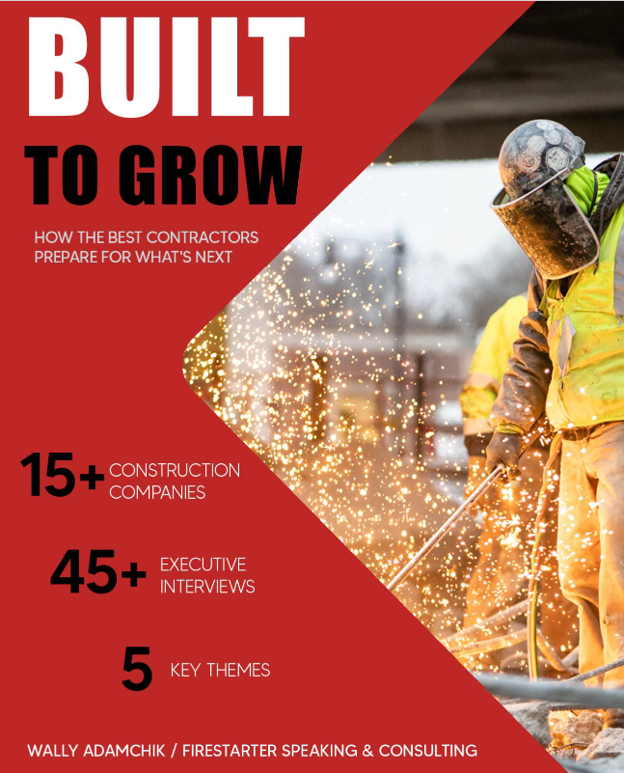
That was the clearest conclusion from more than 45 interviews I conducted with senior executives from 15 of North America’s leading contractors. I wanted to understand what successful construction companies had done to prepare for growth, what they wished they had done sooner, and what other contractors could learn from their experience.
What I heard had surprisingly little to do with chasing revenue. Instead, the conversations kept coming back to leadership capacity, culture, systems, and the organizational discipline required to handle increasing complexity.
Growth changes a company. More people, projects, customers, locations, and business units mean more decisions and more opportunities for misalignment. Things that once happened through a conversation in the hallway now require communication systems. Senior leaders who once knew everyone personally must rely on others to carry the culture and make decisions. Complexity doesn’t increase in a straight line, either. Every new layer creates additional relationships, handoffs, communication paths, and decisions.
The question, then, is not simply whether a company can grow. It is whether its leadership capacity can keep pace with the complexity that growth creates. Five themes emerged from the interviews.
1. Capacity Must Grow Before the Business
The strongest companies invested before they desperately needed to. They developed leaders, hired ahead of demand, worked on succession, and invested in technology and systems before existing capacity became a constraint. Senior executives also made time to coach and develop people even when operations were demanding their attention.
That requires discipline because those investments often look like overhead before the growth arrives. The payoff may not be immediate, but the cost of waiting can be significant. Growth does not create leaders. It reveals whether leadership capacity has kept pace.
2. Culture Becomes More Important as You Grow
In a smaller company, culture can travel through proximity. People know the owner and longtime employees. They learn how things are done through daily interaction and observation. Growth eventually breaks that model.
As companies expand across offices, business units, and geographies, culture has to become more intentional. The best companies do not rely on slogans and posters to preserve it. They reinforce culture through hiring, promotion, communication, recognition, and everyday decisions. The larger the organization becomes, the more important it is to build culture by design, not by default.
3. Systems Scale Culture. They Don’t Replace It.
I expected executives to talk about systems, and they did. What interested me was how they talked about them. The best companies did not see systems as substitutes for leadership or culture. They used systems to extend both.
KPIs, governance, communication processes, and technology helped preserve expectations and align decisions across increasingly complex organizations. Without systems, culture becomes inconsistent and increasingly dependent on individual leaders. Without culture, systems become mechanical and bureaucratic. Sustainable growth requires both.
4. Professionalization Is Not Bureaucracy
Growth requires companies to become more professional. Governance becomes more formal, decision-making becomes more disciplined, outside expertise gets added, and processes become standardized. None of that automatically makes a company bureaucratic.
Bureaucracy is different. It adds layers without adding value. Decisions slow, approvals multiply, silos form, and the organization can become more interested in protecting its processes than serving its customers and people. The companies I studied became more disciplined without losing the identity, urgency, and entrepreneurial thinking that made them successful in the first place. Professionalization enables growth. Bureaucracy limits it.
5. Leadership Is Not a Person. It Is a Process.
This may be the most important finding. Small companies can depend heavily on a few exceptional individuals. Growing companies eventually cannot.
Leadership development, culture, systems, governance, succession planning, communication, and professionalization are not separate initiatives. Together, they create the process through which an organization produces leadership at scale. Instead of repeatedly asking, “Who can fix this?” the better question becomes, “What in our system created this, and how do we improve it?”
The objective is not to make founders, CEOs, or other key leaders less important. It is to make the organization less dependent on any one person.
Pace Matters
One other finding cut across all five themes: the strongest companies maintained urgency as they grew. They did not confuse becoming more disciplined with becoming slower. They invested before they had to, hired before capacity became constrained, and addressed leadership gaps before those gaps became crises.
That may be one of the hardest disciplines of growth. Complexity rarely announces itself in advance. By the time the organization is clearly struggling, the investment required to solve the problem is often already late. The best companies were willing to prepare for problems they did not yet have.
Ultimately, successful contractors cannot avoid complexity. Growth creates it. The challenge is building leadership capacity fast enough to manage it. When capacity keeps pace, complexity can become a competitive advantage. When it does not, organizations find themselves under increasing stress. And even companies that break through must continue evolving or risk eventually falling into bureaucracy.
So perhaps the most important growth question is not, How much do we want to grow?
It is: Are we building the organization that tomorrow’s growth will require, or are we managing the organization that yesterday’s growth produced?
I created the Construction Leadership Capacity Index to help construction leaders answer that question. The free, 25-question assessment takes about five minutes and provides a snapshot of your organization’s readiness for growth. It is available at ConstructionLeadership.com.
The full report is available in the research tab on this site